

Felpreva® – Protection that fits a cat's world
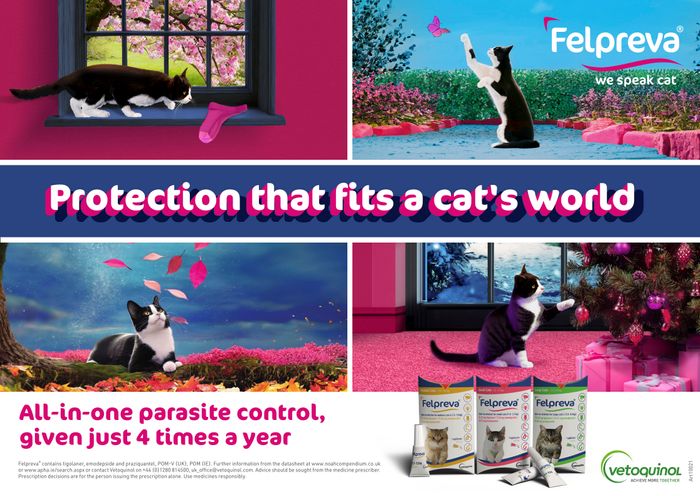
How ‘speaking cat’ changes care:
Feline preventative medicine has advanced significantly in
recent years. However, despite improved clinical understanding and innovation,
many owners still find treating their cats emotionally difficult. In fact,
research showed that 43% of cat owners feel guilty, stressed, or worried about administering
medication to their cats, and 1 in 2 find having to administer more than one
product confusing[1].
For a species that values control, predictability and safety, the experience of
treatment can feel anything but benign. For owners, treatment can become a
moment of stress, avoidance or compromise and can create a gap between clinical
intent and real-world compliance for veterinarians.
If we want prevention to work for cats, for owners and for
clinics, we must look beyond functional performance alone. Calmer and kinder
feline care starts with seeing the world through a cat’s eyes. Parasite
protection should respect their experience and should not feel forced, so the
human-animal bond is preserved, not compromised.
The emotional reality:
Compared to dogs, cats rarely tolerate coercion. They do not
respond well to restraint, rushed handling, or unpredictable experiences. Yet
preventative conversations can often focus on the treatment given, rather than
how it fits into a cat’s life.
For owners, this disconnection matters. This doesn’t stem
from an unwillingness to treat their cat, but from feeling they are breaking trust.
Prevention that causes a struggle or relies on force can result in cats
associating care with fear, eroding owner trust and compliance, and could lead
to the avoidance of treatment and veterinary visits. The fact that the majority
of cat owners said they would prefer to treat against parasites every three
months1 suggests that treatment
frequency and experience may influence owner comfort and emotional burden,
rather than indifference towards their cat’s care.
Speaking cat: a shared responsibility:
Feline care works best when it’s collaborative. Vets, vet
nurses, and owners each play a role in shaping experiences that feel safe,
respectful, and predictable for cats. Séverine Tasker, Veterinary Strategic
Lead, from global cat welfare charity International Cat Care (iCatCare) states
“Cats experience stress differently from other species and recognising this is
fundamental to protecting their welfare and the human-animal bond”. This
principle is central to cat-friendly principles developed by iCatCare and is just
as critical to parasite prevention as it is to routine clinical examinations.
These
principles are embedded within the Cat Friendly
Clinic Programme, an initiative from International
Cat Care that recognises veterinary practices committed to delivering a
feline-centred clinical environment. For practices looking to strengthen their
feline care protocols or benchmark their approach, further information and
resources are available through the International Cat Care website: www.
https://icatcare.org/cat-friendly-clinic.
When veterinary teams take time to “speak cat”, they help
owners understand what cats need to feel safe during care. By explaining how
cats rely on familiarity, gentle handling, predictable routines and how subtle
changes in behaviour can signal stress, prevention can be positioned in a way
that respects a cat’s true nature. This can empower owners to deliver care that
fits their cat’s world, building compliance through reassurance and trust
instead of pressure or force.
Protection that fits a cat’s world:
Effective parasite protection is non-negotiable, as parasites
present a real risk to feline health. However, protection that unsettles a cat
or compromises their sense of safety can be difficult to sustain, particularly
when it creates tension for cats and their owners. This is where shifting
mindset matters. Rather than expecting cats to tolerate treatment, we can
choose protection that accommodates the needs of the cat.
Felpreva®
was developed especially for cats. Not simply as a broad-spectrum parasiticide in
one application, but a solution designed to align with feline behaviour,
lifestyle and tolerance. Because when protection fits a cat’s world, the bond
between cats and the people who love them stays strong.
Beyond treatment – calmer prevention in practice:
Topical prevention is often discussed in terms of technique;
where to apply, how to part the fur and how to prevent licking. Whilst these
details matter, they are not the whole picture. Predictability, minimal
handling, reduced frequency and clear routines are equally important. When
treatment is less frequent, easy to integrate, and facilitates reduced
stressful interactions, cats can remain calmer and owners remain confident.
This presents an opportunity for veterinary professionals to
reframe conversations about parasite prevention beyond coverage and towards how
it is experienced by cats. Through discussing calm handling, preparation and
the value of predictable routines, veterinary teams can help owners deliver
protection in a way that respects feline behaviour and reduces stress. As a
result, prevention becomes easier to maintain, supporting feline welfare and
owner confidence.
Preserving the human-animal bond:
The human-animal bond is delicate, particularly during moments
of stress. Cats remember negative experiences, as do owners. When parasite
protection becomes a source of anxiety, it can influence wider engagement with
care, contributing to delayed check-ups, reluctance to treat, and erosion of
trust between the owner and the practice. Conversely, when prevention feels
manageable, predictable and kind, it reinforces the idea that veterinary care is
carried out in conjunction with the cat, not to them. Felpreva® shares this same belief,
not only protecting feline health, but also the relationship between cats and
the people who care for them.
A shared language to enhance care:
Calmer and kinder feline care is a collaborative effort:
Veterinarians provide the clinical evidence behind what’s
needed. Vet nurses help translate that evidence into compassionate advice,
supporting owners with handling, routines and environment. Whilst owners bring intimate
knowledge of their cat’s behaviour, preferences and boundaries.
When all three speak the same language, grounded in a shared
respect for the cat’s world, protection moves from a struggle and becomes part
of everyday life.
Speaking Cat:
Felpreva®
is more than a product. It embodies the belief that cats are not small dogs and
have their own unique needs. That understanding shapes everything from
formulation to frequency and education to conversations. By aligning protection
with feline behaviour, Felpreva®
supports a future where prevention feels less like an obligation and more like
an act of care. Care that owners can give without guilt, and cats can accept
without fear. In a profession increasingly focused on the wellbeing of animals,
clients and veterinary teams, this matters. Because when we truly understand
cats and speak their language, care becomes calmer. And when care is calmer,
protection works for all involved.
Felpreva®
– We Speak Cat.
Felpreva®
contains tigolaner, emodepside and praziquantel, POM-V. Further information
from the datasheet at www.noahcompendium.co.uk or contact Vetoquinol on 01280
814500, uk_office@vetoquinol.com. Advice should be sought from the medicine
prescriber. Prescription decisions are for the person issuing the prescription
alone. Use medicines responsibly.